Benefits of High Glass Transition, ‘Tg’, Adhesives for Enhanced Reliability Electronic Device Assembly
KRYLEX High Tg Platform - KE9000 Series
Introduction:
The choice of which adhesive to select for a specific electronic application depends upon a number of different and specific requirements. Some properties are physical in nature e.g. Viscosity and thixotropic index, pot life, shelf life, etc. Other factors to consider in relation to the adhesive are mechanical in nature e.g. adhesion on a specific substrate, hardness, Glass Transition Temperature (Tg), Coefficient of Thermal Expansion (CTE), Storage Modulus, outgassing during and post cure, etc. Often the mechanical properties of the adhesive are directly correlated to what level of reliability can be achieved for the final bonded joint in the electronic device. Adhesives used in electronic device assembly are often expected to hold up under significant environmental stress e.g. moving from a cold environment to a warm environment.
The extent to which the mechanical adhesive properties affect the device reliability really depends upon what type of reliability condition the adhesive needs to pass and to what level. It is true however the relationship between the adhesive Tg and CTE is often seen as a critical relationship. As such it is beneficial to understand what these mechanical properties are and how the relationship between the two can directly impact temperature delta reliability concerns.
Glass Transition Temperature (Tg):
The Tg is typically considered to be the temperature at which cured adhesive shifts from a ‘glassy phase’ to a ‘rubbery phase’, or more simply, from a rigid state to a flexible state. The Tg is often expressed as a definitive temperature, although in practice it is a more accurately a temperature range and is affected by the specific peak cure temperature used to react the adhesive (the higher the cure temperature → Higher Tg), atmospheric moisture, and also the specific adhesive formulation constituents.
Coefficient of Thermal Expansion (CTE):
All materials have an important thermal property known as the coefficient of thermal expansion, or CTE. This refers to the rate of volume expansion a material will experience for a given temperature change. It is typically measured in parts per million per degree, i.e., for every increase of 1 °C, the material will expand or contract by 1/10,000th of 1%. In polymer adhesives the CTE is important to understand above the Tg, often referred to as Alpha 1 (α1) and below the Tg, often referred to as Alpha 2 (α2). Most polymer adhesives have similar CTE properties above and below Tg, and so in order to manage CTE lower it is necessary to modify the CTE by incorporating carefully selected inorganic filler constituents into the formulation.
Adhesive Reliability and The Relationship Between Tg CTE
A wide range of factors influence the reliability performance of an adhesive in any given application, and there are numerous perspectives on which material properties are most critical to control in order to ensure robust performance. Although each application presents unique requirements, it is generally accepted that achieving a high glass transition temperature (Tg) combined with a low coefficient of thermal expansion (CTE) is advantageous for maximizing reliability. This becomes especially important when there is a significant CTE mismatch between the polymeric adhesive and the inorganic substrates commonly used in electronic device assembly. Such mismatches introduce mechanical stress into the bonded structure, ultimately reducing bond robustness. The impact of this mismatch is most pronounced at temperatures above Tg (α₁), where the adhesive exhibits higher thermal expansion.
As noted previously, CTE can often be reduced through the incorporation of inorganic fillers within the adhesive formulation. However, maintaining a high Tg provides additional benefits. When the adhesive remains predominantly in the α₂ region during operation—rather than cycling frequently between α₁ and α₂—the stresses associated with CTE mismatch are minimized, resulting in a more reliable bond.
Because the KE9000 series exhibits both a very high Tg and a low CTE, it delivers strong performance in consumer electronic device assembly and is well suited for more demanding applications, such as package or component assembly that must withstand lead‑free reflow conditions
KRYLEX KE9000 Series:
KRYLEX materials chemists have developed a portfolio of adhesives engineered with high glass transition temperatures (Tg) and exceptionally low coefficients of thermal expansion (CTE) to effectively address CTE‑mismatch challenges across a wide range of electronic assembly applications. These include automotive camera module assembly, component staking, corner bonding, high‑performance connectors, and semiconductor package or component assembly.
In addition to their low CTE and high Tg, KE9000 Series adhesives exhibit very low outgassing during both cure and post‑cure stages, making them well suited for assemblies where minimal outgassing is critical to device performance and reliability. The KE9000 Series is also formulated with optimized dispensing theologies tailored to the specific requirements of each application.
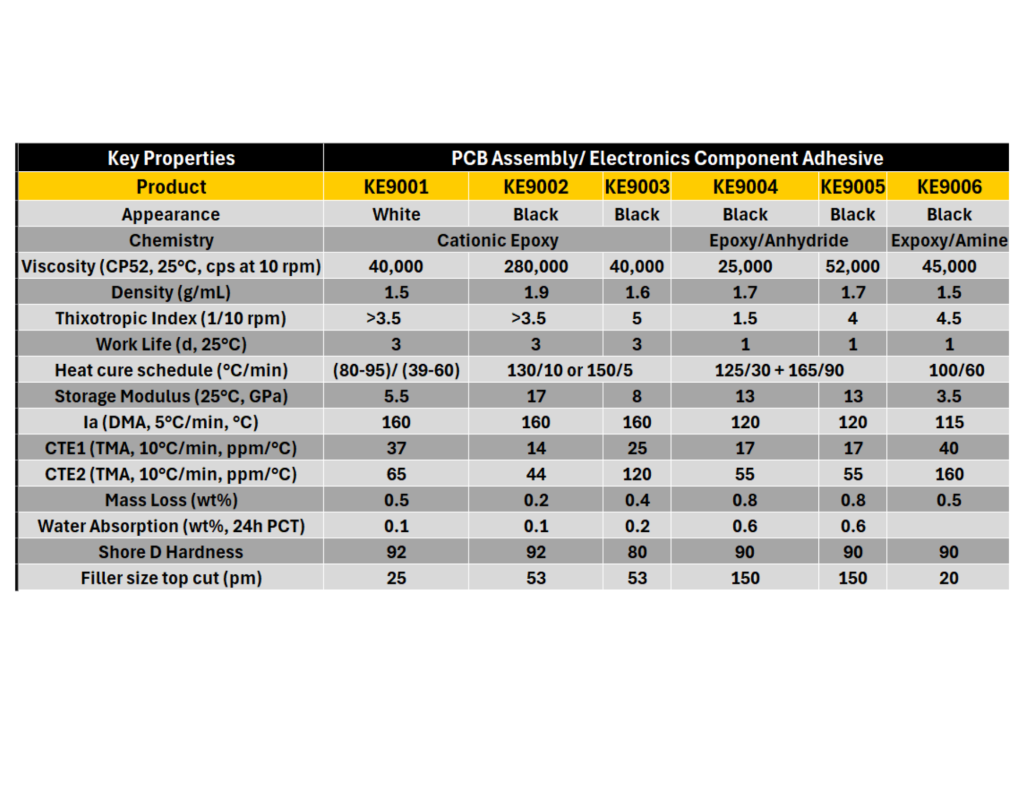
KE9000 Series Material Properties:
KE9000 series have been developed to have a specific range of material properties: -
Summary:
KE9000 series, ‘High Tg’ platform have been developed to enhance the reliability of a variety of electronic device assembly applications. The KE9000 series formulation platform typically offers the following benefits: -
- High Tg.
- Low CTE.
- Very low outgassing during cure and post cure.
- Low and predictable shrinkage.
- Optimised dispense rheology’s for a variety of applications.
- Enhanced Reliability.
For the best product recommendation contact Paul Gleeson (pgleeson@chemence.com your local KRYLEX representative.
Typical Applications:
Connector Assembly/ Electronic Component Construction/ Automotive Active Alignment/ Corner Bonding/ Component Staking/ Fence Bonding/ Die Bonding/ Co-package Optics.
April 3, 2026
Andy Lard