KRYLEX Electrically Conductive Adhesives for Electronic Device Assembly

As consumer electronic devices are required to run at ever-increasing power densities, the Increasing power usage presents several challenges. Two such applications that are seeing significant increases in power usage are Compact Camera modules (CCM) and high-resolution OLED Displays.
These challenges require innovative solutions in power management, thermal design, and signal processing to ensure that compact camera modules or OLED displays can deliver high performance without compromising on size, battery life, or reliability
Increasing power usage in CCM presents several challenges:
- Heat Dissipation: Higher power consumption generates more heat, which can affect the performance and longevity of the camera module. Efficient thermal management solutions are necessary to dissipate heat without increasing the module's size.
- Battery Life: For battery-operated devices, increased power usage can significantly reduce battery life. This is particularly critical for portable devices like smartphones and drones, where battery efficiency is paramount.
- Size Constraints: Compact camera modules need to fit into small spaces, which limits the options for power management and cooling solutions. Designers must find ways to optimize power usage without compromising the module's size.
- Signal Integrity: Higher power usage can lead to increased electromagnetic interference (EMI), which can affect the signal integrity of the camera module. Ensuring robust signal processing and shielding is essential to maintain image quality.
- Cost: Implementing advanced power management and cooling solutions can increase the overall cost of the camera module. Balancing performance, power efficiency, and cost is a significant challenge for manufacturers.
- Reliability: Increased power usage can stress the electronic components, potentially leading to higher failure rates. Ensuring the reliability of the camera module under higher power conditions is crucial for maintaining performance and user satisfaction.
In addition to the above concerns OLED Display also need to manage Image Quality versus negative impacts of increased power density:-
- Image Quality: Higher power usage can lead to issues such as burn-in and image retention, where static images leave a permanent ghostly impression on the screen. This can degrade the overall image quality and user experience.
These significant and consistent challenges require innovative solutions. One way these challenges are often met is through the use of high-performance conductive adhesives.
Conductive Adhesive Usage in Consumer Electronic Device Assembly
As electronic applications continue to run at ever-increasing power densities, the growth in conductive adhesive opportunities is significant, particularly in consumer electronic device assembly applications.
The benefits of using conductive adhesives are numerous: -
- Electrical Grounding: Conductive adhesives provide robust electrical grounding performance, ensuring that any electrostatic discharge (ESD) is effectively removed from the camera module. This helps to protect sensitive electronic components and maintain the module's functionality.
- Thermal Management: These adhesives often have high thermal conductivity, which helps dissipate operational heat generated by the camera module. This improves the performance and reliability of the module by preventing overheating.
- Mechanical Stability: Conductive adhesives can offer a low modulus, which ensures better drop performance and mechanical stability. This is particularly important for the thin, miniaturized substrates within mobile device camera components.
- Compatibility with High-Volume Production: Many conductive adhesives cure at room or low temperatures, which is beneficial for high-volume production environments. This reduces energy consumption and prevents warping or shrinking of the camera module substrates due to excessive heating.
- Space Efficiency: Using conductive adhesives allows for more compact designs, as they can be applied in thin layers without adding significant bulk to the consumer electric device e.g. Camera module, which is often a critical concern in modern electronic device.
These properties make conductive adhesives an ideal choice for ESD grounding, ensuring both electrical and thermal performance while maintaining the integrity of the module's design.
Introduction to Electrically Conductive Polymers and Adhesives
Electrically Conductive filled polymers and adhesives have long been used in electronic applications that require electrical grounding, with the conductive particles creating electrical interconnectivity, creating a path to ground between the sensitive electrical component and the substrate.
In addition to acting as a pathway to ground, conductively filled polymers are often used in electronic device circuitry as the physical traces that carry the electrical current to all necessary components on a printed circuit board.
Traditional Formulation Strategy for Conductive Adhesives:
Conductive adhesives are often formulated with noble metals such as platinum, Gold or most commonly, silver. The addition of the metal to the electrically insulating polymer resin system is required to reach a level whereby the metal is present in such quantity to allow electrical conductivity to develop (after downstream processing e.g. Cure). The point at which ‘resistance’ drops significantly and ‘conductivity’ is developed is often referred to as the percolation point. To drive the development of high levels of conductivity, the % filler added is often required to increase to a point significantly past the percolation point. Indeed, many Electrically Conductive Adhesives (ECA’s) have filler loadings in the range between 70 – 85%. The extent to how much filler is added is dictated by the target conductivity for the specific application and the target mechanical properties required of the adhesive.
Conductivity and the viscosity of the adhesive can also be optimised by careful selection of filler types. In the case of Ag, it is common to be able to purchase Ag particles that are available in either a spherical or flake format. These two types of filler particles are often combined to help optimise the specific product to the needs of the end-use application.
With the advent of newer filler technologies, e.g. nano-filler technology development, the traditional ways to manufacture and produce high-performance conductive adhesives are ripe for change and innovation.
Challenges for Conductive Adhesives for Use in Consumer Electronic Devices:
Traditionally, conductive adhesives were designed for use in applications such as semiconductor die attach. In these kinds of applications, the adhesive is required to bond a silicon chip to a metal-based substrate that could be bare metal or a metal substrate selectively coated with solder mask. In both cases, the substrates are not temperature sensitive, and so the adhesives are designed to cure at ‘high’ cure temperatures, e.g. 150 - 200֯C. For many consumer electronics applications these kinds of process temperatures are not permitted, usually due to the heat sensitivity of the substrates or adjacent components e.g. Low temperature stability plastics (upper temperature limit - typically 80֯C) or OLED Display panel (Upper control limit 60֯C).
The low process temperatures required in many consumer electronic bonding applications pose significant challenges for conductive adhesives: -
- Lower cure temperatures typically lead to lower electrical conductivity, which impacts the potential ESD performance.
- Most one-part, pre-mixed adhesive formulas are often unable to achieve effective cure at temperatures below 80 °C or within a reasonable process time, e.g. > 60 – 90 minutes.
KRYLEX Innovation Driving Next Generation Conductive Adhesive Performance:
KURALOW™ Technology Resin Platform Chemistry:
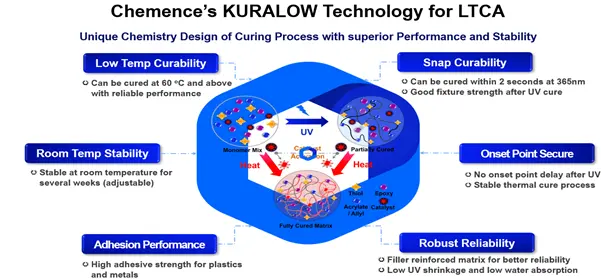
KURALOW™ Technology is high high-performance, high-reliability, 1-Part pre-mixed chemistry platform that enables low temperature cure performance, as low as 55֯C, while having long-term stability at RT to enable robust adhesive dispensing in high throughput manufacturing processes.
The use of KURALOW platform chemistry as the reactive component in the development of conductive adhesives is enabling significant conductivity development at cure temperatures below the temperatures where substrates or active components can be damaged.
KRYLEX Proprietary Filler Technology:
KURALOW™resin Technology enables robust low temperature conductive adhesives to be produced, however KRYLEX materials scientists are also working with novel inorganic fillers and additives that are enabling much lower filler loadings to be considered versus traditional conductive adhesives e.g., approx. 40%. In addition to delivering a significantly lower cost adhesive, the lower filler loading, when incorporated into the KURALOW™resin system, enables robust conductivity development at curing temperatures as low 60֯C. This is changing the game around where conductive adhesives can be used and with what substrates.
For more information on product options or to discuss bespoke development, contact Paul Gleeson at pgleeson@chemence.com.
July 7, 2025
Krylex