Stray Light Blocking Adhesive Technology for OLED Display’s
OLED (Organic Light Emitting Diode) displays have been a widely adopted Display Technology for the assembly of high-end consumer electronic devices for approximately the last 10 years. OLED displays have significant performance advantages over LCD (Liquid Crystal Display) technology. OLEDs use organic compounds that emit light when electricity is applied. Each pixel generates its own light, which means:
- No need for a backlight
- Deeper blacks and higher contrast
- Thinner and more flexible screens
Other Key Advantages of OLED Technology are:
- True blacks: Pixels can turn off completely, giving infinite contrast ratios
- Vibrant colors: Richer and more accurate color reproduction
- Wide viewing angles: Minimal color distortion from the side
- Thin and flexible: Enables foldable phones and ultra-slim TVs
- Energy efficient: Especially when displaying darker content
One consistent challenge for OLED displays is the impact that ambient ‘stray light’ can have upon display image quality and subsequent impact upon the user experience. Stray light concerns are:
1. Reduced Contrast and Black Levels
OLED displays are known for their perfect blacks because individual pixels can turn off completely. However, stray light—from ambient sources or internal reflections—can illuminate these black areas, reducing the perceived contrast.
2. Color Accuracy Degradation
Stray light can scatter across the screen and mix with emitted light from the OLED pixels, leading to:
- Washed-out colors
- Inaccurate color reproduction, especially in dark scenes
3. Glare and Visual Discomfort
In dark environments, stray light can cause:
- Glare or halo effects around bright objects
- Eye strain due to inconsistent brightness levels across the screen
4. Image Ghosting or Blooming
Stray light can cause blooming, where bright areas bleed into dark ones. This is especially noticeable in:
- High-contrast scenes (e.g., white text on a black background)
- UI elements like subtitles or HUDs in games
5. Internal Reflections and Optical Crosstalk
Within the OLED panel layers, light can reflect and scatter, leading to:
- Crosstalk between pixels
- Loss of sharpness or clarity in fine details
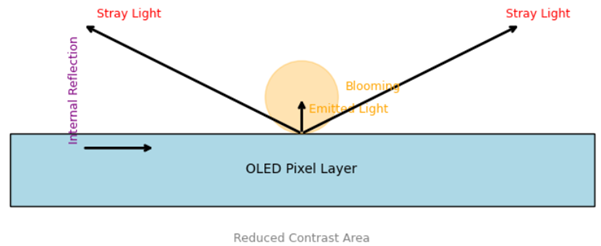
The below image demonstrates how stray light can be problematical. Stray Light: Enters from external sources or reflects internally, interfering with the intended image.
- Internal Reflections: Light bouncing within the display layers, causing ghosting or blur.
- Blooming: A halo effect around bright areas due to light scattering.
- Reduced Contrast Area: Where black levels are compromised by stray illumination.
Key Elements in the Diagram:
- OLED Pixel Layer: The source of emitted light.
- Emitted Light: Travels directly toward the viewer.
- Stray Light: Enters from external sources or reflects internally, interfering with the intended image.
- Internal Reflections: Light bouncing within the display layers, causing ghosting or blur.
- Blooming: A halo effect around bright areas due to light scattering.
- Reduced Contrast Area: Where black levels are compromised by stray illumination.
Adhesives for OLED Display Light Blocking:
A common solution to help prevent OLED Display light leakage is the use of an optical black adhesive layer. Because OLED Display’s are sensitive to elevated temperatures in assembly the use of a thermal cure solution is typically not an option, as such non-thermal cure chemistries are desired.
UV curing is an ideal fit as the adhesive chemistry class can be cured in a few seconds and does not impart significant heat to the OLED substrates. Beyond their light blocking benefits black Pigmented UV adhesives have the following advantages: -
- Speed and Efficiency: They cure within seconds under UV light, significantly reducing production times.
- High Precision: Ideal for intricate designs, ensuring clean and accurate bonding.
- Strong and Durable Bonds: They provide excellent adhesion to glass, plastics, metals, and ceramics.
- Eco-Friendly: These adhesives reduce the need for volatile organic compounds (VOCs), making them a sustainable choice.
- Deep Layer Curing: Advanced formulations allow black adhesives to cure in deeper layers using UV light, eliminating the need for secondary curing methods.
- Storage Convenience: Some black UV adhesives can be stored at room temperature, avoiding the need for deep-freezing.
One historical limitation for Black UV light blocking adhesive is that they are required to be pigmented to help block the light. Pigmenting UV adhesive using additive fillers and dyes helps block the light but can also significantly impact the effectiveness of the UV cure itself. Conversely if the pigmentation level is too low this can result in insufficient light blocking performance. The extent the pigmentation level has on the cure depends somewhat on the formulation and what the Optical Density (OD) target for the display is.
KRYLEX Adhesives Technology for OLED Light Blocking
Using traditional filler technologies, the relationship between OD and filler content is very similar irrespective of the formulation design e.g. a required formula % is required to reach a specific OD value. As the OD target is increased the extent of black pigment required needs to go up. This relationship between black filler and OD has implications for UV adhesives in that the greater concentration of filler significantly impacts the ability of the UV light to penetrate the adhesive layer and fully cure the product. This direct relationship means that ‘high’ OD values are harder to achieve and even lower OD values are difficult to achieve when the required adhesive layer is thin e.g. 100 microns and below.
KRYLEX material scientists have formulated Black UV adhesives that incorporate novel filler technology which is enabling higher OD values than traditional filler technologies, at both thick and thin bond lines.
KRYLEX® KU5169A is a black, acrylate adhesive developed for tack free adhesive applications in electronic display edge sealing. The product provides excellent OD performance at a variety of thicknesses.
KU5169A Product Features
- Product Features.
- Instant cure with 405 LED and Broadband light.
- Black in color.
- Optical density (OD) of 1.56 @ 100µm thickness and depth of cure 300µm
- Tailorable OD
- Scratch and abrasion resistant adhesive/coating.
- Dry to touch in open face curing application.
- Multi substrate adhesion.
- Excellent adhesion on glassMedium viscosity for optimal flow in sealant applications.
- Cure condition: 10s at 600mW/cm2, 405nm.
KU5169 Series Chemistry:
KU5169 chemistry is a high performance UV curable chemistry and is being leveraged into multiple applications. A variety of product formulas are available and offer easy processing excellent adhesion low and high surface energy plastics and metals. In addition the product chemistry is formulated to have excellent reliability performance and offers excellent product robustness in hot wet environments:

For more information on KU5169A or any product in KU5169 series contact Paul Gleeson at pgleeson@chemence.com or register a request for more information via KRYLEX.COM.
November 13, 2025
Krylex